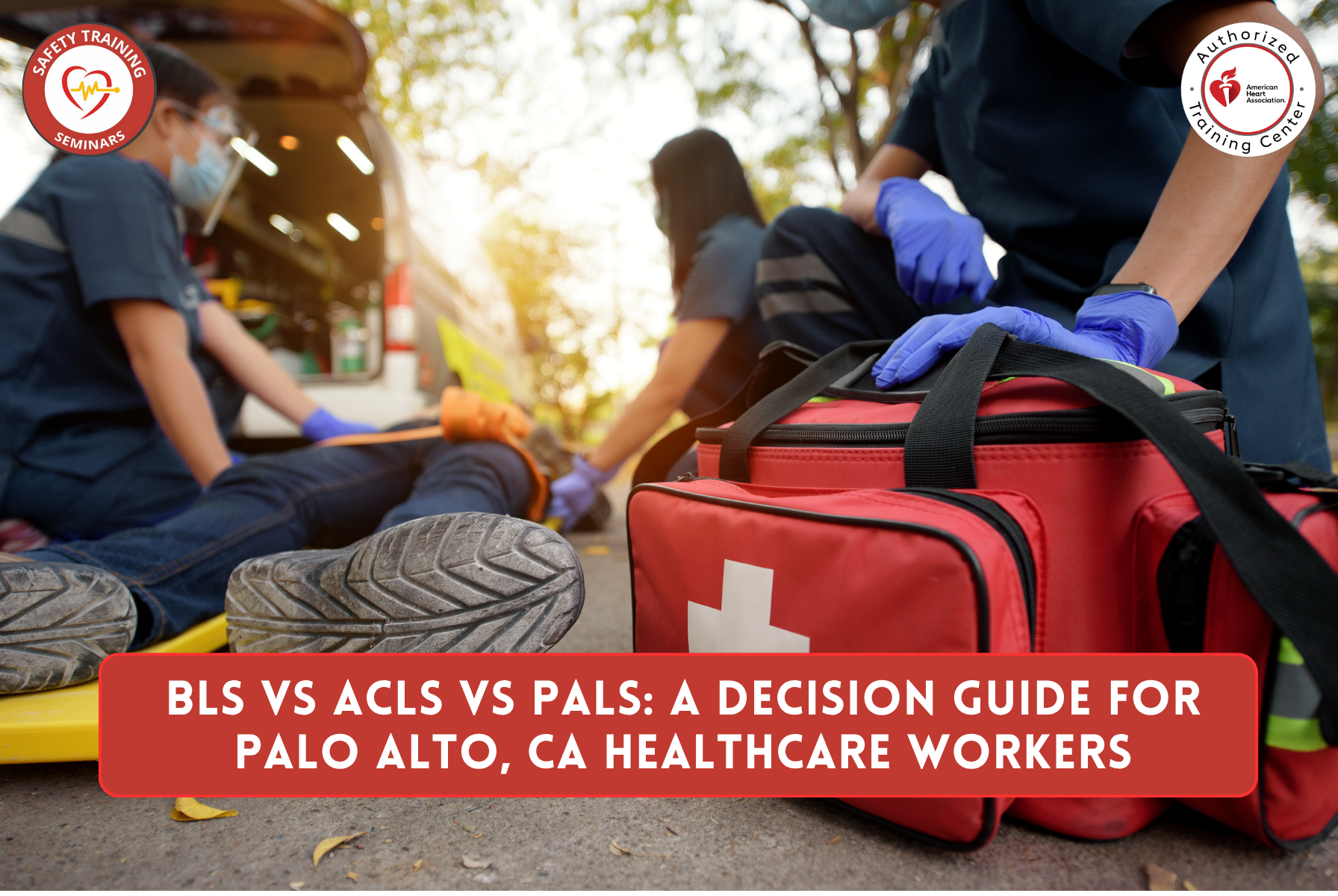
If you work in a hospital, clinic, dental office, or school setting in Palo Alto, CA, the certification you need depends largely on your job title and the patients you’re likely to encounter. A medical assistant at a Stanford-area clinic has different requirements than an ICU nurse managing a code, and both differ from a pediatric urgent care tech. This guide breaks down what BLS, ACLS, and PALS cover, who typically needs each one, and how to figure out which course fits your role before you register.
What BLS, ACLS, and PALS Actually Cover
BLS, or Basic Life Support, teaches high-quality CPR, AED use, and choking relief for adults, children, and infants. It’s built for the first moments of a cardiac or respiratory emergency, before advanced equipment or medications enter the picture. Most clinical, dental, and allied-health roles use BLS as their baseline requirement.
ACLS, Advanced Cardiovascular Life Support, builds on BLS with algorithm-based management of cardiac arrest, stroke, and acute coronary events in adults. It covers medication administration, rhythm recognition, and team-based resuscitation roles typically used in emergency departments, ICUs, and cath labs.
PALS, Pediatric Advanced Life Support, applies that same advanced framework to infants and children. It focuses on recognizing respiratory distress and shock before a child deteriorates into cardiac arrest, since pediatric emergencies usually progress differently than adult ones.
Who Typically Needs Each Certification
Course selection generally follows job function rather than personal preference, though your employer or program should always confirm the exact requirement.
- BLS — nurses, medical assistants, dental hygienists, EMTs, respiratory therapists, nursing students, and most direct patient-care staff
- ACLS — RNs and providers working in emergency departments, intensive care, telemetry, or cardiac catheterization settings
- PALS — pediatric nurses, NICU and PICU staff, school nurses, pediatric dental teams, and EMS providers who regularly transport children
- BLS only, non-clinical adjacent roles — teachers, coaches, childcare staff, and fitness professionals who want CPR readiness without an advanced clinical scope
If your job description doesn’t clearly state which course applies, your HR department, clinical educator, or state licensing board is the most reliable source, since requirements can vary by employer and by unit.
When Your Role Touches Both BLS and ACLS
Some Palo Alto healthcare workers move between departments or take on charge-nurse and preceptor duties that expand their scope. A telemetry nurse who occasionally floats to the ED, for example, may need both BLS and ACLS current at the same time. In that situation, most people complete BLS first, since ACLS courses assume BLS-level CPR proficiency rather than teaching it from scratch.
It’s also common for new graduate nurses to complete BLS during orientation and add ACLS once assigned to a higher-acuity unit. If you’re unsure whether your assignment calls for both, ask your nurse manager directly, since carrying an unnecessary certification wastes time and carrying too few can delay a placement.
Where PALS Changes the Picture
Pediatric physiology doesn’t scale down from adult physiology in a straight line, which is why PALS exists as its own course rather than an add-on module. Children compensate for respiratory distress differently, their airways are proportioned differently, and drug dosing is weight-based rather than fixed. A provider who’s strong in ACLS but has never taken PALS may still miss early warning signs specific to pediatric decompensation.
Anyone working regularly with infants or children clinically — pediatric offices, school health rooms, PICU units, or pediatric dental practices — should treat PALS as a distinct requirement, not something ACLS already covers. Some roles require both if the unit treats a mixed adult and pediatric population, which is worth confirming with a supervisor first.
In-Person, Blended, and Online Skills Verification
Most current BLS, ACLS, and PALS courses fall into one of two formats: fully in-person instruction, or blended learning where students complete the cognitive portion online and attend an in-person session to demonstrate hands-on skills. An online-only certificate, without a supervised skills check, is generally not accepted by hospitals or clinical programs, since compression depth, rate, and AED coordination can’t be verified remotely.
Blended courses tend to work well for people who already have some CPR background and want to save time on the classroom portion. First-time students, or anyone rusty on technique, usually benefit more from a fully in-person class where an instructor can correct form in real time.
Certification Needs Across Palo Alto’s Healthcare Community
Palo Alto’s mix of hospital systems, research institutions, and outpatient clinics means certification requirements can vary even within a few blocks of each other. A nursing student completing clinical rotations may need BLS on a tight timeline before a placement starts, while a cardiac unit nurse renewing ACLS is usually working around shift schedules rather than a hard deadline. Dental offices typically require BLS renewal on a set cycle tied to state board rules, and childcare centers and school staff generally need BLS with pediatric content rather than the advanced PALS track.
Because Palo Alto sits close to several other Santa Clara County communities, it’s common for students to compare course availability across nearby cities, including Mountain View and Santa Clara, if scheduling works out better elsewhere.
Where to Complete Course Enrollment and Skills Testing
Safety Training Seminars operates a training center in Palo Alto at 467 Hamilton Avenue, Suite 5, Palo Alto, CA 94301, offering BLS, ACLS, PALS, NRP, and First Aid course options for healthcare professionals, students, and workplace teams in the area. For most first-time students or anyone renewing a lapsed card, the BLS CPR certification course in Palo Alto page outlines what’s currently offered locally and is a reasonable starting point before registering.
Choosing a local option can simplify scheduling around clinical rotations or shift work. Before enrolling, confirm the specific course, format, and renewal timing directly with the training center, and separately confirm with your employer or school which certification your role requires. Students outside Palo Alto, including San Jose or Morgan Hill, can review those city-specific pages if closer to home.
Frequently Asked Questions
Do I need BLS before I can take ACLS or PALS?
Yes, generally. ACLS and PALS courses build directly on BLS-level CPR skills and don’t reteach basic compressions or AED use from scratch. Most training providers expect current BLS knowledge going in, even if a separate BLS card isn’t formally required for enrollment. Confirm the specific prerequisite with your training provider before signing up.
Can I complete ACLS or PALS entirely online?
Typically no. Most employers and clinical programs require an in-person or supervised skills-check component to verify hands-on technique, even when the cognitive portion is completed online through a blended format. A certificate issued without any hands-on verification may not be accepted for clinical employment. Always check your employer’s specific policy first.
How do I know if my job requires BLS, ACLS, or PALS?
Your job description, HR onboarding materials, or direct supervisor are the most reliable sources, since requirements vary by department, employer, and sometimes by state licensing board. A general rule of thumb is that direct patient-care roles need BLS, high-acuity adult units need ACLS, and pediatric-focused roles need PALS. When in doubt, ask before you register rather than after.
Is a BLS card from a course taken outside Palo Alto accepted locally?
In most cases, a valid card is accepted regardless of which city the course was completed in, as long as it comes from a recognized provider and format your employer accepts. Some hospital systems or school districts do specify particular training organizations, so it’s worth double-checking before assuming any card will work. When possible, confirm this with your HR department ahead of your renewal date.
Do nursing students in Palo Alto need a different course than working nurses?
Nursing students typically need the same BLS certification as working nurses, since clinical programs generally require the same baseline CPR proficiency for rotations. Where students often differ is timing, since programs may require certification well before a rotation begins rather than on an ongoing renewal cycle. Check your program handbook for the exact deadline and course type it specifies.
Making Your Next Move
Matching your role to the right certification comes down to a few consistent questions: what patient population you work with, whether your unit handles advanced cardiac or pediatric emergencies, and what your employer or program specifically requires. BLS covers the baseline for most direct patient-care work in Palo Alto, while ACLS and PALS apply to more specialized adult and pediatric settings. If you’re unsure which course applies to your position, confirming with your supervisor or program coordinator first will save you from taking the wrong class or missing a deadline. From there, reviewing current course availability at a local training center, including the options offered through Safety Training Seminars in Palo Alto, is a practical next step toward getting scheduled.