Palo Alto runs on tight calendars — residents rotating through clinical services, research staff moving between labs and patient care, and tech professionals whose meetings rarely respect a fixed class time. That’s part of why American Heart Association (AHA) Self-Guided Learning has caught on with so many people here. The format pulls apart the two halves of a certification course: you complete the knowledge portion online at your own pace, then handle the required hands-on skills separately, in person. What follows explains how Self-Guided Learning applies across BLS, ACLS, PALS, CPR, AED, and First Aid, which course matches which role, and how someone in Palo Alto, California can settle on the right one without paying for a class that won’t meet their requirement.
Key takeaway: AHA Self-Guided Learning lets you complete the cognitive coursework independently while still doing the in-person skills check that provider certifications require. The course you choose should follow your professional role and the rules set by your employer, school, or licensing body — not whatever slot is open.
What AHA Self-Guided Learning Actually Is
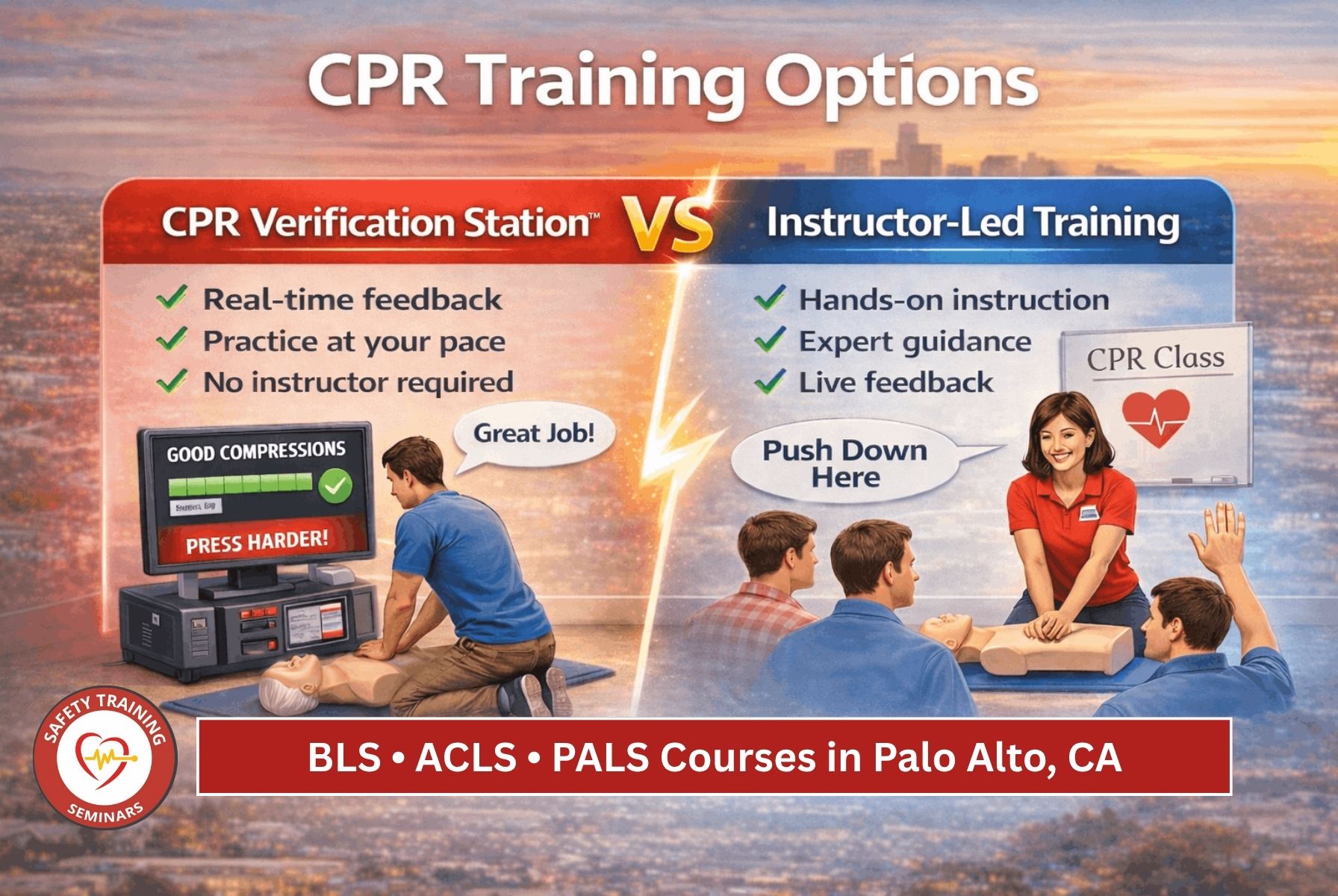
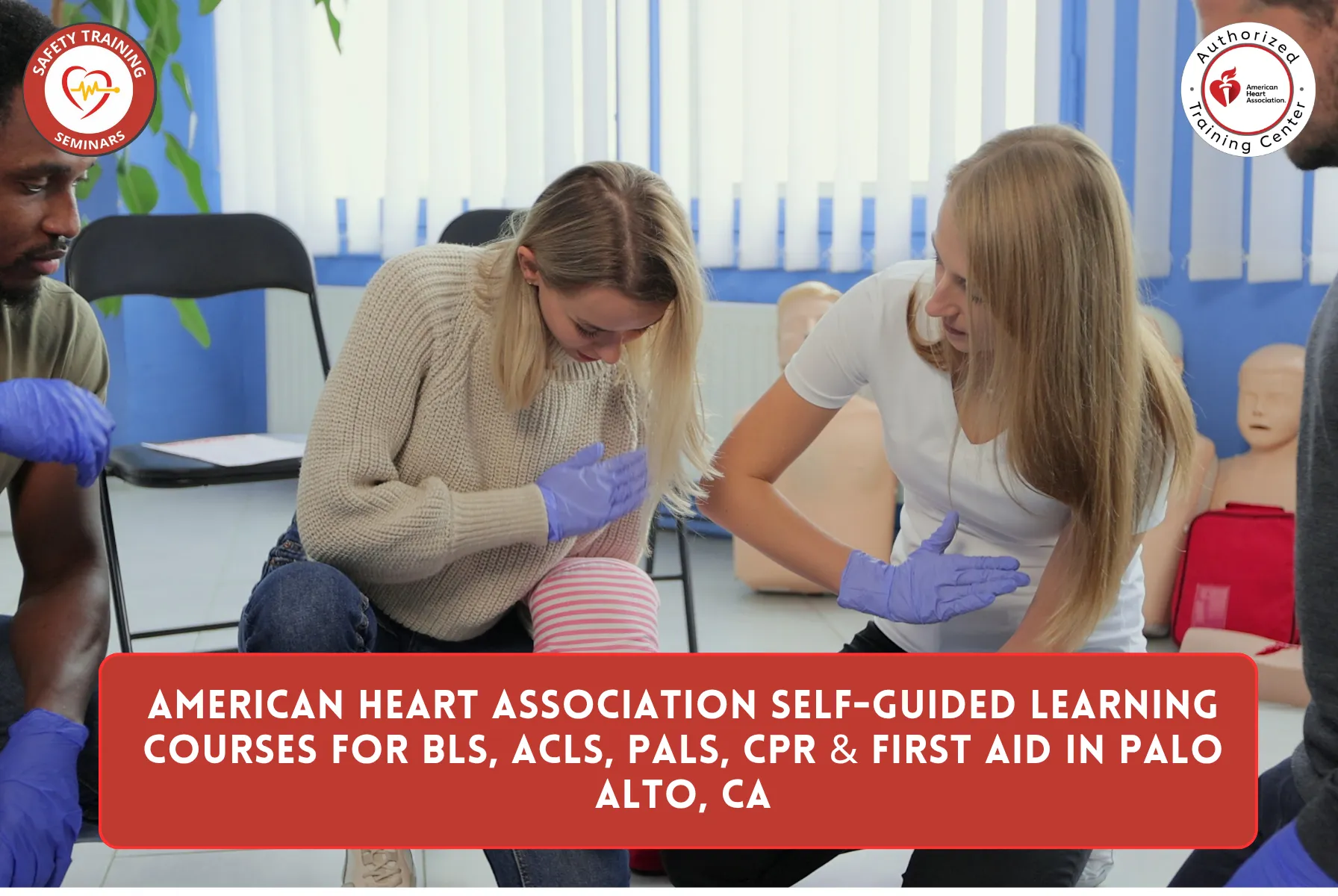
Self-Guided Learning is built around flexibility, not a stripped-down course. You complete the cognitive material — typically an adaptive online module — whenever it fits your schedule. For provider-level courses, the second half is a hands-on skills session done in person on equipment that gives real-time feedback, frequently at an AHA CPR Verification Station learning center. That skills portion completes the certification; the online work alone doesn’t.
In broad strokes, the process looks like this:
- Identify the course your role or requirement calls for.
- Finish the online knowledge module at your own pace.
- Schedule and attend the in-person skills session where required.
- Pass the hands-on skills check for provider courses.
- Receive the matching course completion card or provider eCard.
The details differ by course, so confirm the format for your specific class before committing.
The Provider-Level Courses
Basic Life Support (BLS)
BLS sits at the base of the clinical pathway. It’s built for people whose work may demand more than public CPR — nurses, physicians, medical and nursing students, EMTs, paramedics, dental staff, and other clinical personnel. Compared with a layperson class, BLS goes deeper into team resuscitation, airway management, and high-quality compressions for patients of every age. Requirements aren’t identical across roles, so confirm what your program or workplace asks.
Advanced Cardiovascular Life Support (ACLS)
ACLS is where the academic-medical crowd in Palo Alto often turns. Designed for healthcare professionals who manage adult cardiovascular emergencies, it’s common among emergency physicians, critical-care and cardiac nurses, anesthesia providers, paramedics, and residents in acute settings. The course adds electrocardiogram interpretation, pharmacology, and the coordination to run a resuscitation team under pressure. Because the requirement depends on specialty and setting, treat ACLS as role-driven rather than universal, and confirm how current your certification must stay. If you’re mapping out a provider track, the ACLS and PALS course options in Palo Alto lay out what the self-guided route involves.
Pediatric Advanced Life Support (PALS)
PALS focuses on emergencies in infants and children, and it’s intended for clinicians who may care for young patients — pediatric and neonatal nurses, emergency staff, pediatric residents, and providers in units that treat kids. The self-guided structure mirrors the others: independent cognitive work, then a hands-on skills session. Pediatric assessment differs meaningfully from adult care, which is why PALS is its own course. If children are part of your patient population, check whether PALS is on your list.
CPR, AED, and First Aid
Not everyone who needs training works in medicine. University staff, lab and office teams, fitness instructors, coaches, childcare providers, and family caregivers often complete CPR/AED or First Aid to meet a workplace policy or to be ready at home. These courses teach compressions, rescue breathing, defibrillator use, and basic injury care, no clinical background assumed. Because employer expectations vary, ask which course and card yours accepts before enrolling — you can compare general CPR and First Aid classes in Palo Alto to see what’s offered locally.
Matching the Course to Your Role
Choosing the wrong class costs time and money. Here’s the typical audience for each:
| Course | Typical audience |
| BLS | Healthcare professionals and clinical students |
| ACLS | Clinicians managing adult cardiac emergencies |
| PALS | Clinicians managing pediatric emergencies |
| CPR/AED | General public and workplace staff |
| First Aid | Schools, childcare, workplaces, community members |
Use it as orientation, not a rulebook. The course you need can hinge on your employer, school, licensing board, or healthcare organization, so verify the requirement and accepted format before paying. When unsure, the office requesting your certification can name the right course.
Self-Guided, Classroom, and Online-Only Compared
These three aren’t the same thing:
- Self-Guided Learning pairs independent online study with an in-person skills session for provider courses. You control the study pace but still demonstrate skills in person.
- Traditional classroom training brings the learning and skills together in one scheduled, instructor-led session, which suits people who prefer a teacher guiding them live.
- Online-only training takes place entirely on a screen. It may suit certain awareness-level courses, but it often won’t satisfy a requirement that includes a hands-on skills check — common for provider certifications.
No format wins for everyone. The right choice comes down to your schedule, how you learn, and what your certifying body will accept.
Why the Format Fits Palo Alto
The rhythm of work here rewards flexibility. A resident finishing overnight shifts, a nursing or allied-health student balancing coursework and clinical placements, a lab researcher pulled between projects, or a startup lead squeezing certification between sprints can all handle the online portion in whatever window appears. Someone traveling in from Menlo Park, Mountain View, East Palo Alto, or Los Altos can complete the reading at home and reserve one trip for the skills session. Renewals fit especially well — when the material is already familiar, the value is getting quickly to the hands-on check.
Safety Training Seminars in Palo Alto
For learners looking at a local option, Safety Training Seminars operates a Palo Alto location at 467 Hamilton Avenue, Suite 5, Palo Alto, CA 94301. As you weigh it, focus on the specifics that affect your certification: which course you need, whether it covers the hands-on skills your role requires, and what card or eCard you’ll hold at the end. Confirm the course format and that the completion documentation will be recognized by your employer or school before registering. Aligning the class with your requirement is what keeps the process smooth.
Frequently Asked Questions
Does the Self-Guided route work for ACLS and PALS, not just BLS? Yes. AHA Self-Guided Learning is offered for BLS, ACLS, and PALS. For each, you complete the cognitive coursework independently, then finish an in-person skills session for the provider certification. The courses differ in content and requirements, so pick the one that matches your clinical role and confirm the specifics before enrolling.
Can I do the online coursework before booking my skills session? Yes. The standard order is to finish the cognitive module first, then attend the hands-on skills session. That sequence is what makes the format practical for residents, students, and professionals with shifting schedules — the reading happens on your time, and the in-person visit stays focused. Check the exact steps with the provider for your course.
I’m a healthcare student near Palo Alto — which course do I need? It depends on your program and placement. Many clinical students need BLS, while those heading into acute-care or pediatric settings may also need ACLS or PALS. Rather than guess, ask your school or clinical coordinator which certification and card they require, since expectations differ by program and rotation.
Can someone from a nearby city train at a Palo Alto center? Yes. Learners from Menlo Park, Mountain View, East Palo Alto, Los Altos, and other neighboring communities can use a Palo Alto location, often convenient for people already commuting in. Still, confirm course availability and scheduling ahead of time.
Is an online-only certificate accepted for clinical work? Often not. Many provider roles require a hands-on skills check that a fully online course can’t provide. If your position calls for BLS, ACLS, or PALS, verify whether an online-only certificate is accepted — in most clinical settings, it won’t be enough on its own.
Choosing Your Next Step
The key distinction is simple: Self-Guided Learning still includes the hands-on skills many certifications require, while an online-only course may not. Before registering anywhere in Palo Alto, confirm which course your employer, school, or licensing organization requires, then make sure the format you choose covers those in-person skills. Once the requirement is clear, reviewing what Safety Training Seminars offers locally — and matching it to your role — makes the final call an easy one.