One of the most well-known academic medical centers in the country is located in Palo Alto, which is a city that is also home to an abundance of startup offices, preschools, youth sports fields, and bustling downtown stores. One hundred percent of the people who work or live in this area will never work in an emergency room. On the other hand, a significant number of them might be the first people to arrive to the scene in the event that a coworker passes out, a toddler chokes, or a biker falls down on a residential street.
This is the target demographic for which a course that teaches CPR and first aid certification is intended. This article provides information on the things that are taught in the Heartsaver® First Aid CPR AED course offered by the American Heart Association (AHA), how it differs from the Basic Life Support (BLS) training that is necessary for many clinical professions, which California regulations may have an impact on your decision, and how to locate a local class in the downtown area of Palo Alto.
What a Heartsaver CPR & First Aid Course Actually Teaches
The AHA Heartsaver® First Aid CPR AED course is built for people with little or no medical training. It serves learners who need course completion documentation for a job or regulatory requirement, as well as anyone who simply wants to be ready to help. The course combines two skill sets that are often taught separately: resuscitation and everyday emergency care.
The CPR and AED portion
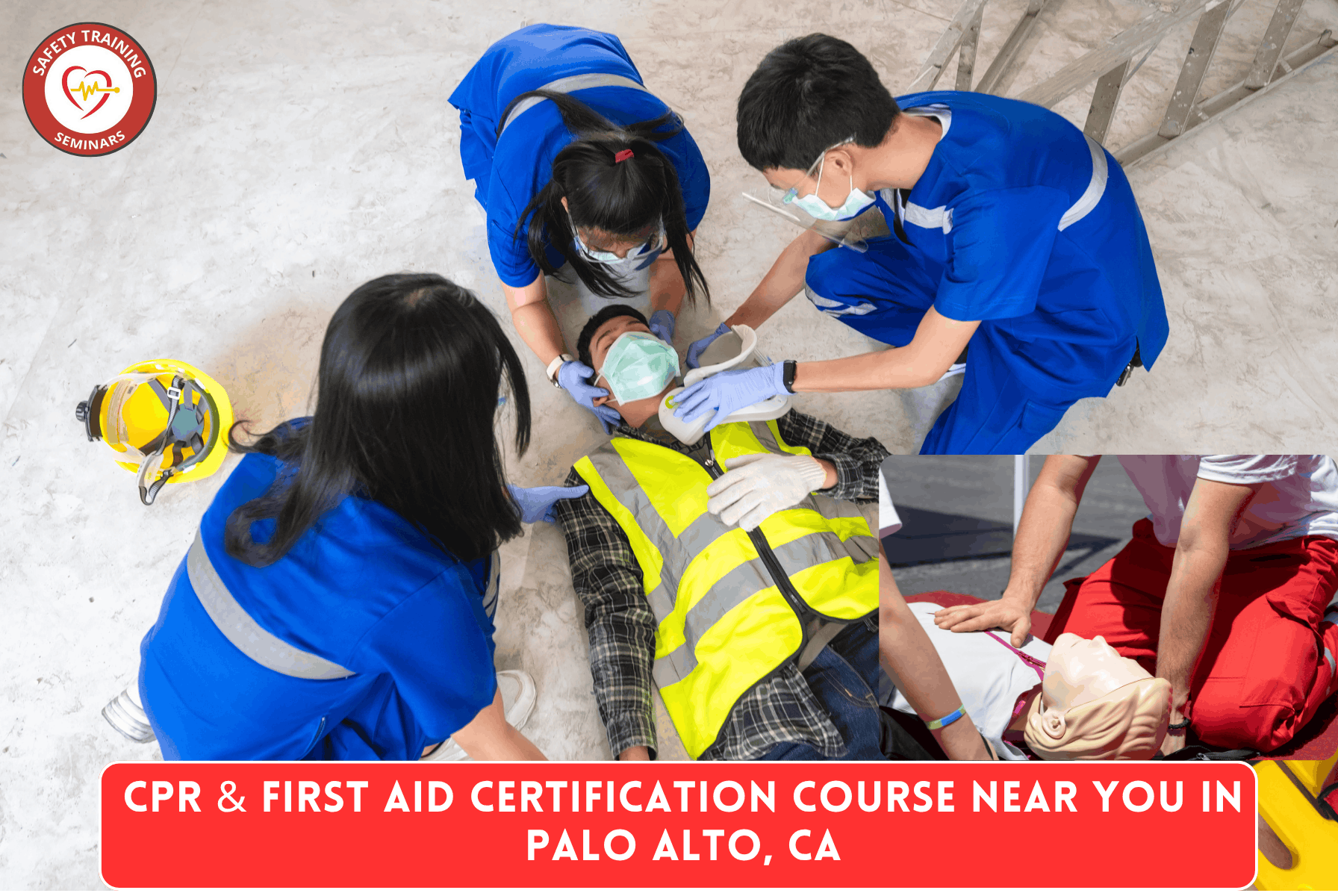
Cardiopulmonary resuscitation (CPR) keeps oxygen-rich blood moving to the brain when the heart stops pumping effectively. An automated external defibrillator (AED) is a portable device that analyzes the heart’s rhythm and delivers a shock when one is needed. In this part of the course, learners practice:
- Recognizing a person who is unresponsive and not breathing normally
- Calling 911 and sending someone to get an AED
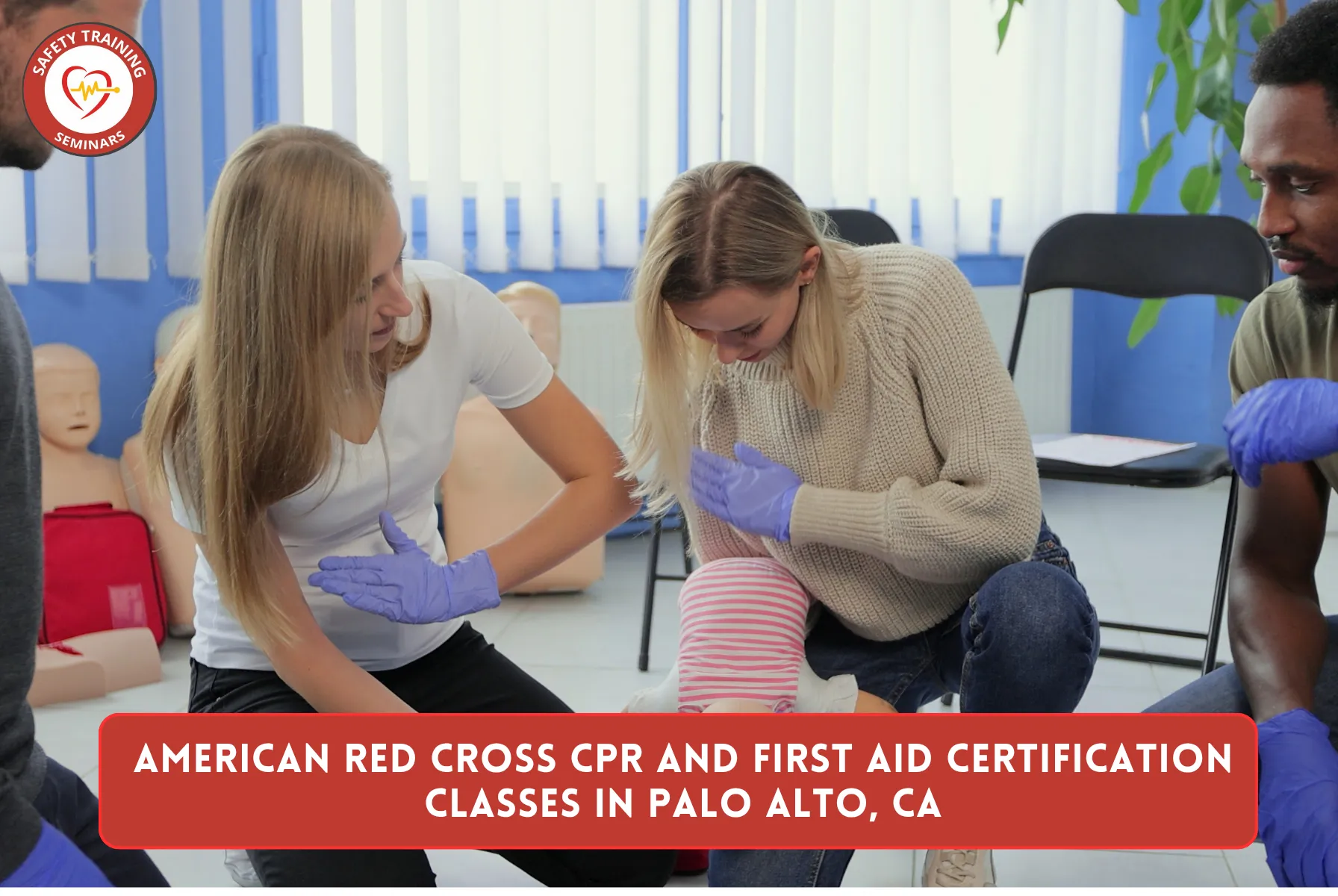
- Giving chest compressions at the correct depth and rate on a manikin
- Turning on and using an AED with practice equipment
- Helping an adult who is choking
Adult CPR and AED use form the core of the course. Child CPR and AED use and infant CPR are offered as optional modules, so anyone who looks after young children should confirm those modules are included.
The First Aid portion
First Aid is the immediate care given for an injury or sudden illness until emergency medical services (EMS) arrive. Heartsaver First Aid content is organized around:
- Medical emergencies: signs of heart attack and stroke, severe allergic reactions and epinephrine auto-injector use, breathing problems, and opioid-associated emergencies
- Injury emergencies: controlling serious bleeding, burns, sprains, broken bones, and shock
- Environmental emergencies: heat- and cold-related illness, bites, and stings
- Prevention: reducing the chance of illness and injury in the first place
Learners complete a First Aid skills demonstration and a CPR and AED skills test. Those who complete the course successfully receive an AHA Course Completion eCard for Heartsaver First Aid CPR AED, which is generally valid for two years.
Who in Palo Alto Takes This Course, and Who Needs Something Different
The right course depends less on where you live and more on what you are expected to do in an emergency. In Palo Alto, that sorts learners into two broad groups.
Lay responders, the group Heartsaver is designed for, include:
- Office managers and safety coordinators at companies downtown and in Stanford Research Park
- Preschool, daycare, and after-school program staff
- Teachers, coaches, camp counselors, and fitness instructors
- Nannies, babysitters, and family caregivers of young children or older relatives
- Residents who want practical preparedness for home, travel, and recreation
Those who work in clinical settings and interact directly with patients are typically required to take a different course. The VA Palo Alto Health Care System, which is affiliated with the Stanford University School of Medicine, is located on Miranda Avenue in Palo Alto. Stanford Hospital, which is located on Pasteur Drive, and Lucile Packard Children’s Hospital Stanford, which is located on Welch Road, are both located in Palo Alto. Instead, it is normal practice to request that students, nurses, medical assistants, and physicians who are placed in situations similar to these take the American Heart Association’s Basic Life Support (BLS) course. Because the requirements are determined by each business or program, it is imperative that you always confirm them in writing.
Heartsaver CPR & First Aid vs. BLS at a Glance
| Heartsaver First Aid CPR AED | BLS (Basic Life Support) | |
| Intended learner | General public and workplace responders | Healthcare professionals and students |
| Typical setting | Offices, schools, childcare, homes, sports | Hospitals, clinics, EMS, clinical placements |
| CPR focus | Single-rescuer CPR and AED use; child and infant modules optional | Adult, child, and infant CPR with team-based resuscitation and ventilation devices |
| First Aid content | Yes, a major part of the course | Not included |
| Usually requested by | Employers, licensing programs, schools, individuals | Hospitals, healthcare employers, nursing and allied health programs |
If your role includes both patient care and general workplace safety duties, you may need more than one course. Ask before you book.
California Rules That Can Shape Your Choice
Two state frameworks come up often for Palo Alto learners.
First aid in the workplace
When there is no infirmary, clinic, or hospital in close proximity that is utilized to treat injured employees, employers are required under Title 8, Section 3400 of the California Occupational Safety and Health Administration to have a person or persons who are appropriately trained to provide first aid. Employers are responsible for evaluating their own workplaces because the rule does not establish a single headcount for each and every workplace. Additionally, Cal/OSHA has been amending Sections 3400 and 1512, mostly concerning the contents of first aid kits; therefore, safety coordinators should evaluate the text that is currently in effect.
Care for children
Specific day care center employees and family child care licensees are required to undergo health and safety training in accordance with Section 1596.866 of the California Health and Safety Code. This training must include pediatric first aid and pediatric cardiopulmonary resuscitation (CPR). That instruction needs to be kept up to date. Courses that have been approved by the California Emergency Medical Services Authority (EMSA) are typically recommended to childcare providers in order to fulfilll the requirements for obtaining a license. That criterion might not be satisfied by a typical workplace training; therefore, it is important to check for approval before enrolling.
Three Questions to Answer Before You Register
- Whom are you most likely to help? If your answer includes infants or young children, look for a course that covers child and infant CPR, or an EMSA-approved pediatric course if you work in licensed childcare.
- Who is asking for your documentation? Ask your HR team, licensing agency, or school for the exact course name it accepts. “CPR certification” can mean very different courses to different organizations.
- Which learning format fits your schedule? Some learners prefer a single classroom session. Others choose a blended option, completing the knowledge portion online and then attending an in-person hands-on skills session. Either way, hands-on skills practice is part of earning the AHA Course Completion eCard.
Once you have those answers, comparing options for a CPR & First Aid certification class in Palo Alto becomes a quick, focused decision.
Training with Safety Training Seminars in Downtown Palo Alto
Safety Training Seminars is an American Heart Association Training Center founded in 1989. Its Palo Alto training center is located at 467 Hamilton Avenue, Suite 5, Palo Alto, CA 94301, in the downtown core.
The center lists Heartsaver CPR and First Aid for the general public, covering CPR for all age groups, AED use, bleeding control, and epinephrine auto-injector use. It also offers healthcare-provider courses, including BLS, ACLS (Advanced Cardiovascular Life Support), and PALS (Pediatric Advanced Life Support), so one location can serve both lay responders and clinical teams. Safety Training Seminars also lists EMSA course options for Palo Alto, which childcare providers can review against their licensing requirements.
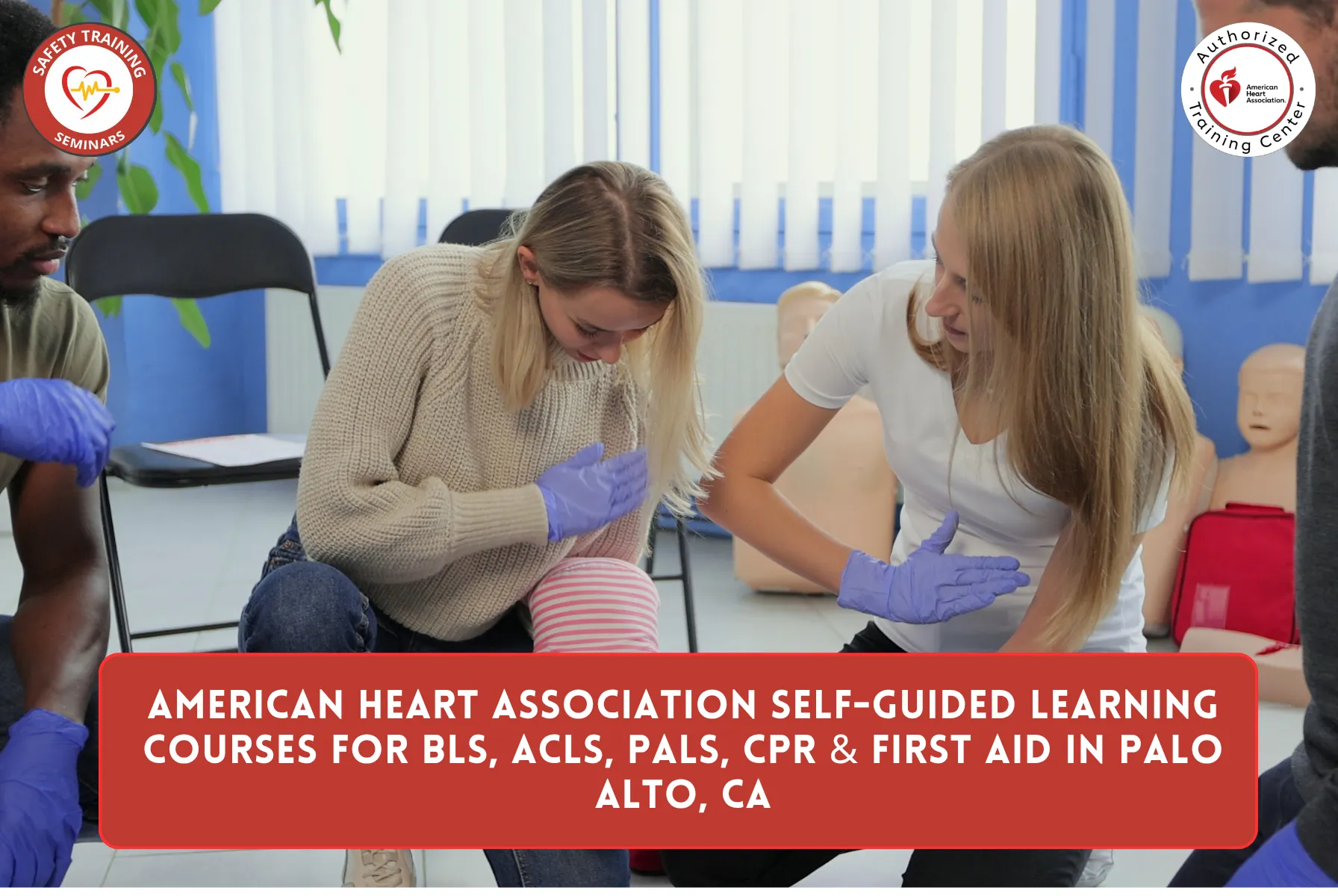
For learners who complete the online portion through AHA Self-Guided Learning™, the Palo Alto site operates a CPR Verification Station™, where students complete hands-on skills practice and testing on CPR manikins and AED training devices.
The downtown location is also practical for neighboring communities. Learners come from Menlo Park and East Palo Alto to the north and from Mountain View and Los Altos to the south. Current dates, formats, and fees are posted on the Palo Alto CPR & First Aid course page, so check there for the latest details before you plan your visit.
Questions Palo Alto Learners Often Ask
Is a CPR & First Aid certification course the same as BLS?
No. The AHA Heartsaver First Aid CPR AED course is designed for lay responders and includes First Aid. BLS is a healthcare-provider course focused on high-quality CPR, team-based resuscitation, and ventilation devices, and it does not include First Aid. Clinical employers and nursing programs usually ask for BLS.
Will the course teach infant and child CPR?
Adult CPR and AED use are the core of the course, and child and infant CPR are available as optional modules. If you care for young children at work or at home, confirm that these modules are part of the class you choose.
Does this course meet California childcare licensing requirements?
Not automatically. Childcare providers covered by Health and Safety Code Section 1596.866 need pediatric first aid and pediatric CPR training, and licensing typically points to EMSA-approved courses. Confirm a course’s EMSA approval before you enroll.
What documentation will I receive?
Learners who successfully complete the course receive an AHA Course Completion eCard, generally valid for two years. Acceptance is decided by each employer, school, or licensing body, so check its requirements first.
Can I complete the entire course online?
The knowledge portion can be completed online in a blended format, but an in-person skills session is required to receive the AHA Course Completion eCard. Practicing compressions and AED use on real training equipment is a central part of the course.
Your Next Step
The training that is most beneficial to you is the one that corresponds to the types of sudden situations that you are most likely to encounter and the paperwork that you are actually need to submit. You should first verify those two points, and then select a format that is suitable for your week.
In addition to Basic Life Support, Advanced Cardiovascular Life Support, and Pulse Defibrillation, the downtown center of Safety Training Seminars, located at 467 Hamilton Avenue, Suite 5, provides AHA Heartsaver CPR and First Aid, as well as Basic Life Support, Advanced Cardiovascular Life Support, and PALS. The current class options can be reviewed and registered for through the course page. If you have any questions regarding which course is appropriate for your role, you can call (650) 272-0772 and ask them about it.