Palo Alto, California, located in Santa Clara County, stands at the heart of innovation and world-class healthcare. With leading medical institutions such as Stanford Health Care, Lucile Packard Children’s Hospital, and nearby VA Palo Alto Health Care System, the demand for advanced life-saving education continues to grow. Healthcare professionals, researchers, educators, and even tech employees in Palo Alto increasingly recognize the importance of BLS, ACLS, and PALS learning experiences to respond confidently in emergencies.
Neighborhoods like Old Palo Alto, Midtown, Barron Park, and Crescent Park reflect a community that values both education and safety. With nearby cities such as Menlo Park, Mountain View, and Redwood City contributing to regional healthcare demand, BLS CPR training near Palo Alto has become more essential than ever. Public awareness around cardiac arrest survival rates and pediatric emergency response continues to rise, especially in a highly educated and proactive community.
Today, learners in Palo Alto can choose between traditional Instructor-Led Training and modern Self-Guided Learning™ courses using CPR Verification Station™ learning centers. This guide provides a detailed comparison to help you choose the most effective and convenient option.
Overview of CPR Training Options in Palo Alto
Before diving deeper, here’s a quick overview of the two primary learning formats:
Instructor-Led Training
A classroom-based program led by a course instructor, where participants attend scheduled sessions and practice skills in a structured group environment.
Self-Guided Learning™ + CPR Verification Stations
A flexible learning experience combining online coursework with hands-on skills assessment at a CPR Verification Station™ learning center.
Traditional Instructor-Led CPR Training in Palo Alto
Instructor-led CPR programs have long been the standard for emergency response education. In Palo Alto, these sessions are commonly attended by professionals working at Stanford Health Care and surrounding medical facilities.
These programs take place in classroom settings where a trainer explains key concepts, demonstrates techniques, and supervises hands-on practice. Learners engage in group discussions and simulated emergency scenarios, helping them develop confidence in real-life situations.
Due to Palo Alto’s central role in Silicon Valley, many participants commute from nearby cities like Mountain View and Menlo Park to attend these sessions.
How Instructor-Led Training Works
Participants enroll in a scheduled session and attend in person. The trainer leads the program by presenting essential material, demonstrating procedures, and guiding learners through hands-on exercises.
Throughout the session, participants practice responding to emergency scenarios such as cardiac arrest and pediatric care. At the end of the program, learners are evaluated on their performance. Upon successfully completing the course, they receive an AHA Course Completion eCard.
Limitations of Instructor-Led Classes
While instructor-led programs are effective, they may not always suit modern lifestyles.
Professionals in Palo Alto often work demanding schedules, especially in healthcare and tech industries. Fixed class timings can make attendance difficult for individuals balancing work and personal commitments.
Additionally, commuting across Silicon Valley traffic can add extra time. These sessions also require several continuous hours, which may not be ideal for those seeking faster and more flexible options.
The Rise of CPR Verification Stations in Palo Alto
As technology continues to evolve, CPR training methods are adapting. CPR Verification Stations are becoming increasingly popular across Palo Alto and Santa Clara County.
Modern learners prefer training options that offer flexibility and efficiency without compromising quality. This shift aligns with the fast-paced lifestyle of professionals in the region.
What Is a CPR Verification Station?
A CPR Verification Station™ learning center is a technology-driven system designed to evaluate hands-on CPR skills with precision.
The system provides real-time feedback, measuring key performance metrics such as compression depth and rate. This ensures accurate and objective evaluation, helping learners improve their technique effectively.
How Self-Guided BLS, ACLS, and PALS Courses Work
Self-Guided Learning™ courses offer a modern and efficient approach to CPR education.
Participants begin with online modules powered by True Adaptive™ learning powered by Area9 Lyceum. This system adapts to each learner’s progress, creating a personalized learning experience.
After completing the online portion, learners visit a CPR Verification Station™ learning center in Palo Alto to complete their hands-on skills assessment. These programs often follow the HeartCode® Complete course format, combining flexibility with quality.
Upon successful completion, participants receive an AHA Course Completion eCard.
Key Advantages of CPR Verification Stations
This modern approach offers several important benefits:
- Flexible scheduling for busy professionals
- Faster completion compared to traditional programs
- Convenient access across Palo Alto and nearby areas
- Objective, technology-based performance evaluation
These advantages make it a preferred choice for many learners.
Why Healthcare Professionals in Palo Alto Prefer Self-Guided Learning
Healthcare professionals in Palo Alto often manage demanding schedules across multiple facilities.
Residents in neighborhoods like Midtown and Barron Park benefit from the flexibility of Self-Guided Learning™. They can complete coursework at their own pace and schedule their skills session when convenient.
This approach is especially valuable for those balancing work, research, and personal commitments.
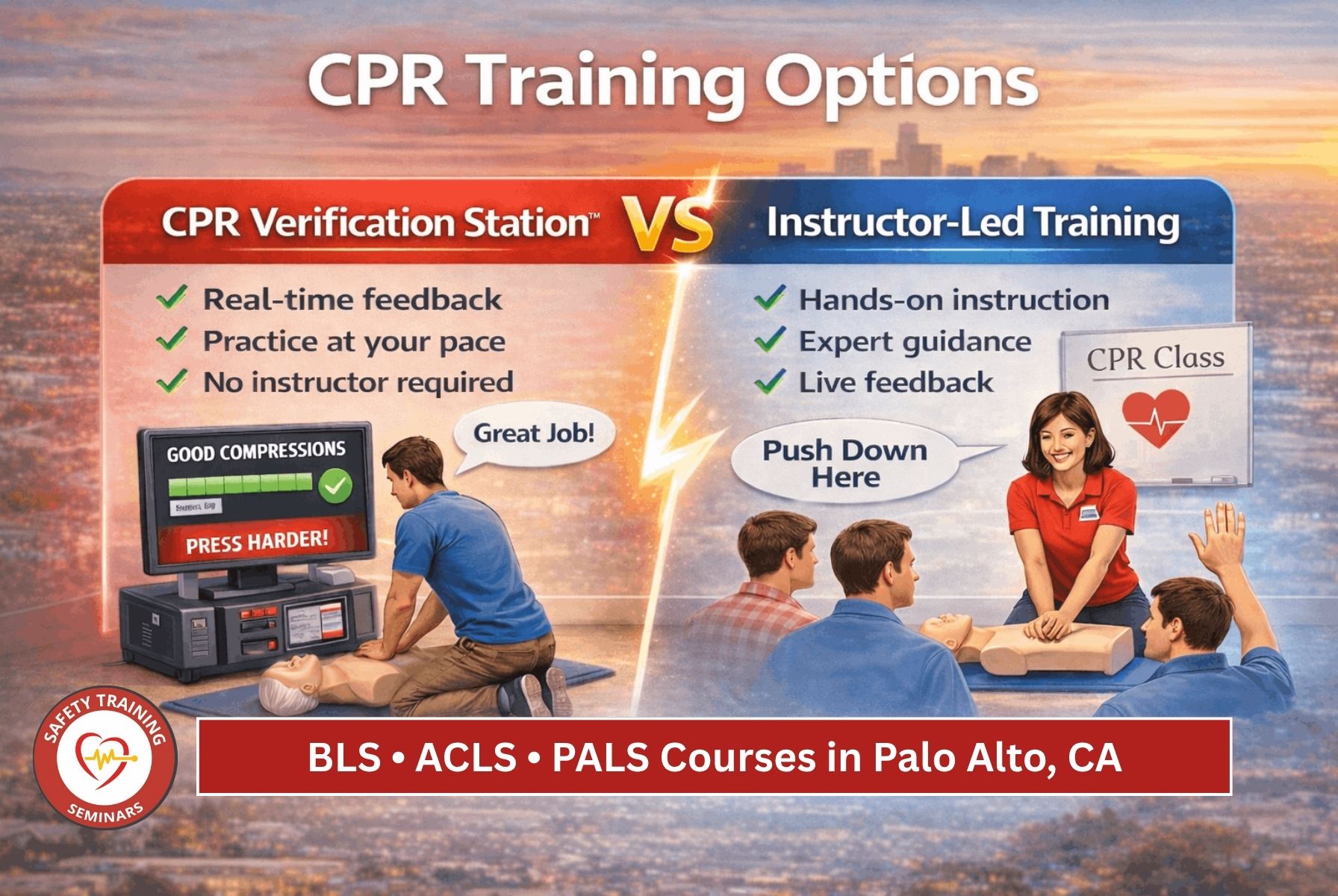
Instructor-Led vs. CPR Verification Stations: Side-by-Side Comparison
Instructor-led programs provide structured learning with direct interaction between learners and trainers. This format is ideal for those who prefer classroom environments and guided instruction.
In contrast, CPR Verification Stations offer greater flexibility. Learners can complete the online coursework anytime and visit a nearby location for skills testing. This reduces scheduling conflicts and saves time.
Evaluation methods also differ. Instructor-led sessions rely on trainer observation, while verification stations use advanced technology to ensure consistent and accurate performance assessment.
Which Option Is Better for You in Palo Alto?
Choosing the right learning experience depends on your needs.
Instructor-led programs are ideal if you prefer structured learning environments, direct guidance, and group interaction.
Self-Guided Learning™ is better suited for individuals with busy schedules who want flexibility, faster completion, and convenient access to training.
Local Demand for CPR BLS, ACLS, and PALS Training in Palo Alto
The demand for CPR training continues to grow across Palo Alto and Santa Clara County.
Healthcare facilities such as Stanford Health Care, Lucile Packard Children’s Hospital, and VA Palo Alto Health Care System rely on trained professionals who can respond effectively in emergencies. Renewal requirements also drive continuous enrollment in BLS Certification Course in Palo Alto, ACLS Certification course in Palo Alto, and PALS Certification training in Palo Alto.
Nearby cities like Menlo Park and Mountain View further contribute to the increasing demand for CPR training near Palo Alto.
How Safety Training Seminars Supports Modern CPR Training
Safety Training Seminars provides accessible and high-quality CPR programs throughout Palo Alto.
Their courses are designed to meet the needs of modern learners, offering both instructor-led sessions and Self-Guided Learning™ options. With convenient locations and flexible scheduling, participants can complete their training efficiently.
Their commitment to quality and accessibility makes them a trusted provider in the region.
The Future of CPR Training in Palo Alto
CPR education is evolving with advancements in technology and changing learner preferences.
Self-Guided Learning™ and CPR Verification Stations are becoming the preferred choice for many professionals due to their flexibility and efficiency. As healthcare demands continue to grow, these modern solutions will shape the future of CPR training in Palo Alto.
Start Your BLS, ACLS, or PALS Course in Palo Alto Today
If you’re ready to begin or renew your training, Palo Alto offers both traditional and modern learning options.
Whether you prefer a classroom-based experience or a flexible self-paced program, you can find a solution that fits your needs. With increasing accessibility, enrolling in a BLS class in Palo Alto or a PALS Class in Palo Alto has never been more convenient.
Take the next step today and choose a program that supports your professional growth while fitting seamlessly into your schedule.